
We announce the launch of an activity-based probe that is designed to selectively target USP7: UbiQ-314. Reported by Gjonaj et al., probe UbiQ-314 is based on Ub with the following mutations: T7D, L8Y, I13R, E34L, Q40N, L69A, and L71A. In addition:
-
Lys58 contains a biotin tag which, besides detection and binding, also serves to increase USP7 selectivity by prohibiting binding of most USPs
-
the N-terminus is functionalised with a 5-carboxyrhodamine110 dye (cRh110, exc/emi 480/520 nm) allowing for sensitive (and fast in-gel fluorescence) detection
-
a cysteine residue is introduced between the dye and N-terminus for further modification with thiol-reactive tags
-
a C-terminal propargyl amide (PA) warhead forms a covalent linkage with the active site Cys of USP7 – this can be cleaved by treatment with 5% aq. TFA, allowing for proteomic analyses.
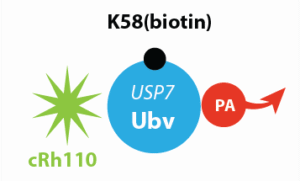
Figure 1. K58K(biotin) cRh110-Cys-Ubv(USP7)-PA (UbiQ-314)